
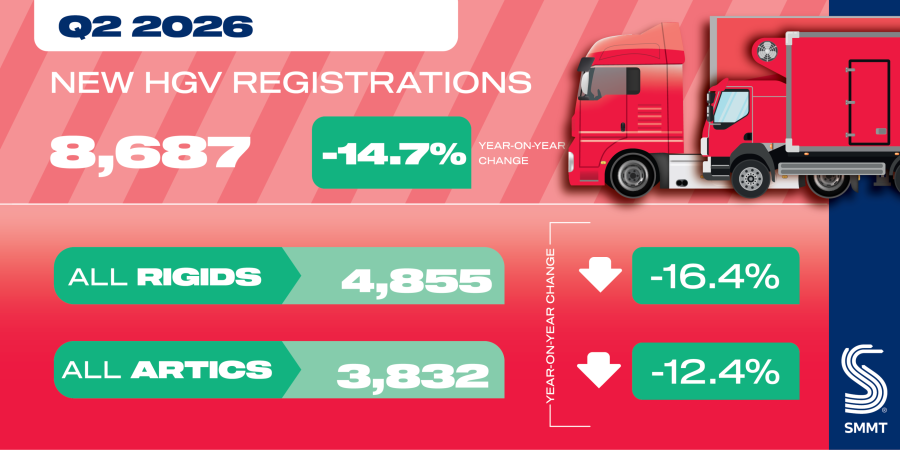
UK HGV registrations fell by 14.7% during the second quarter of 2026 as fleet operators slowed vehicle replacement programmes amid continued economic pressures, according to the latest figures from the Society of Motor Manufacturers and Traders (SMMT).
A total of 8,687 new heavy goods vehicles entered service between April and June, taking registrations for the first half of the year to 18,158 units, down 8.9% compared with the same period in 2025.
Despite the softer market, registrations of zero emission trucks increased slightly during the quarter. However, battery electric models still accounted for less than 1% of all new HGV registrations.
Fleet renewal slows
The latest figures suggest the market is beginning to normalise following three years of strong post-pandemic fleet replacement activity.
Demand fell across both major vehicle sectors during the second quarter, with articulated truck registrations declining by 12.4% to 3,832 units, while rigid trucks dropped by 16.4% to 4,855 units.
Tractor units remained the largest single vehicle category, accounting for more than two in every five new HGV registrations despite volumes falling 13.7% to 3,706 units.
Body type registrations also reflected weaker demand across much of the market. Box vans recorded the sharpest decline, down 36.6%, while curtain-sided vehicles fell by 26.4%.
Not every sector experienced a downturn, however. Registrations of tippers increased by 12.7%, while refuse collection vehicles recorded the strongest growth, rising by 27%.
Zero emission trucks remain a small part of the market
While the overall market contracted, zero emission HGV registrations rose modestly during the quarter.
A total of 90 zero emission trucks were registered, an increase of 4.7% compared with the same period last year. This lifted quarterly market share from 0.8% to 1.0%.
The longer-term picture remains less encouraging.
Across the first six months of 2026, zero emission registrations fell by 6.6% compared with 2025. Market share remained unchanged at just 0.9%, illustrating how early the sector still is in its transition away from diesel.
The SMMT noted that last year’s figures were boosted by funding through the Zero Emission HGV and Infrastructure Demonstrator (ZEHID) programme.
Infrastructure continues to hold back adoption
According to the SMMT, manufacturers now offer an increasing range of zero emission HGV models, but operators continue to face significant barriers to investment.
Higher purchase prices remain a challenge, alongside delays in securing electricity grid connections and a lack of suitable public charging infrastructure for commercial vehicles.
The organisation says government support through initiatives such as the Plug-in Truck Grant, the Depot Charging Scheme and the ZEHID programme has helped stimulate early demand.
However, it argues that further action is needed, including faster grid connections, quicker planning approvals for depot charging installations and a long-term national charging infrastructure strategy.
The SMMT believes these measures would improve operator confidence while recognising the differing operational requirements across the HGV sector.
Industry calls for greater confidence
Commenting on the latest UK HGV registrations, SMMT Chief Executive Mike Hawes said the market slowdown was not unexpected after several years of exceptionally strong demand.
“After three bumper years of fleet renewal, the HGV market is now under pressure,” he said.
“The fact that zero emission truck uptake is outperforming the market is a crumb of comfort but at less than 1% of the market it is not a cause for celebration.”
Hawes added that government support has helped establish the market but warned that operators need greater certainty before investment in zero emission vehicles will accelerate.
“Government support has helped incubate this emerging market, but if the sector is to decarbonise at pace, operators need confidence, and that means addressing key barriers to investment and a technology-neutral approach that recognises the diversity and complexity of HGV use.”
The latest figures underline the challenge facing the commercial vehicle industry as it balances difficult trading conditions with the transition to lower emission transport. While manufacturers continue to expand their zero emission ranges, widespread adoption is likely to depend on improved infrastructure, reduced operating uncertainty and continued policy support.
More Information
- Society of Motor Manufacturers and Traders (SMMT): https://www.smmt.co.uk
For more like this visit the Trucking Magazine website (https://truckingmag.co.uk), or subscribe to Trucking Magazine here (https://shop.kelsey.co.uk/trucking-magazine).