
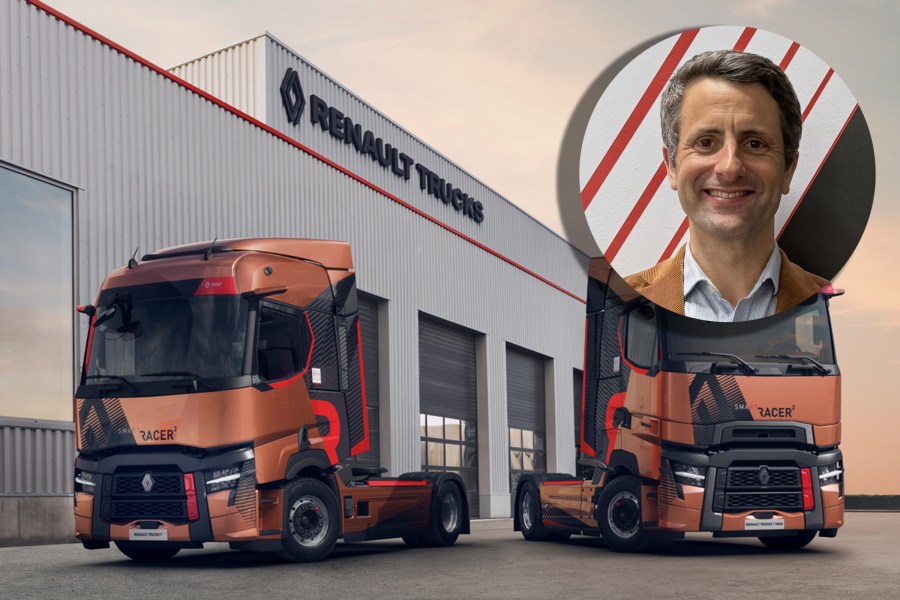
Renault Trucks UK and Ireland is targeting a major expansion of its light commercial vehicle business as new managing director Aymeric Larcher begins to shape the manufacturer’s next phase of growth.
Larcher, who took up the role on 1 May 2026 after previously serving as head of key account sales at Renault Trucks France, said the UK and Ireland had become one of the brand’s most important European markets. His appointment followed the promotion of Carlos Oliveira Rodrigues to a senior vice president role within Renault Trucks Europe.
Speaking exclusively to Trucking at RTX 2026, Larcher said his immediate task was to translate Renault Trucks’ wider 2030 brand ambition into a specific plan for the UK and Ireland.
“The UK and Ireland is definitely a big market for Renault Trucks,” he said. “It has become our second market. The UK and Ireland team received the 2025 Market of the Year, which demonstrates that a good job has been done and recognised.”
He said the market remained highly strategic because UK operators are among the most demanding in Europe. He added that this pressure helped Renault Trucks develop products and services that better meet real-world operating needs.
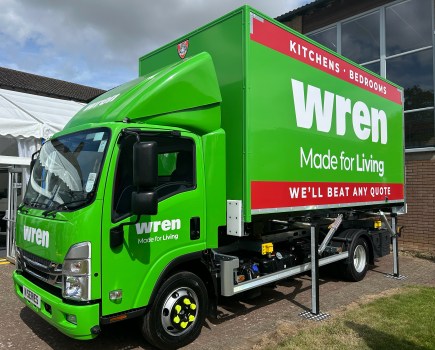
A key part of the plan will be growth in the van segment. Larcher said Renault Trucks had “the ambition to double” its light commercial vehicle business in the UK by 2030.
The push will focus heavily on the Renault Trucks Master range. It will also include a new fully electric “software-defined vehicle” due to arrive next year, which will sit above the Trafic platform.
Larcher said Renault Trucks and its dealer partners had already invested heavily in the van sector. The network currently has 12 dedicated van centres in the UK, with more planned.
“We push a little bit more service mindset B2B into the van business,” he said. “This is very appreciated by the customers.”
He argued that this service-led approach would be critical as new low-cost entrants enter the van market. He said customers did not only buy a product but also relied on the service, support and relationships behind it.
“The experience you have is much more than the product,” he said. “It’s the services, it’s people-to-people when you have an issue to manage. You need this proximity and close relationship.”
Larcher also offered a pragmatic view of the zero-emission transition. He said operators were still grappling with economic uncertainty, geopolitical pressures and cost inflation. Their immediate focus remained on efficiency and uptime.
He said Renault Trucks’ parent, Volvo Group, gave the brand access to shared technology platforms, including battery-electric, hydrogen combustion and fuel-cell capabilities. However, he said hydrogen was increasingly likely to remain a niche option.
“The more we look at it, the more we see hydrogen being a niche,” he said.
Battery-electric technology, he suggested, remains the most likely long-term direction for much of the market. However, he said the transition would take time and that operators needed options in the near term.
“To me, the question is not so much whether operators will go,” he said. “It is more about how and when it will shift.”
Asked about Renault Trucks’ relationship with Volvo Trucks in the UK, Larcher said the brands shared group technology but remained commercially independent.
“We belong to the same group, which means we have access to common technology platforms,” he said. “But each brand owns its future. Each brand decides what it wants to develop and how it wants to pick from the portfolio, from a product perspective and from a service perspective. We have very different DNA and very different retail strategies, and we compete fully in the market.”
Renault Trucks has also been gaining share in the heavy truck market in the UK and Ireland. Larcher said the brand ended last year with a 7.5% market share across the UK and Ireland combined. He added that this was close to double the level achieved six or seven years ago.
He added that Renault Trucks had grown by an average of around 0.5 percentage points per year over that period.
“It has been a steady, consistent growth,” he said. “It shows the good work that has been done by the dealers and the team to meet customer demands.”
Larcher said he hoped the brand could maintain that trajectory this year, although he stopped short of setting a firm market-share target.
“We are aligned with 7.5%, but we have good hopes that at the end of the year we will achieve a constant growth of 0.5,” he said. “Of course, we will see. We don’t know yet, but we have good business development.”
He also said Renault Trucks needed to do more to engage operators and drivers to get behind the wheel of its vehicles. Driver influence is becoming more important as fleets compete to retain staff.
“When we look at the feedback from customers, those who choose to go with us are satisfied and want to continue with us,” he said. “We should not take it for granted. It is an everyday battle.”
Larcher’s comments indicate that, under its new leadership, Renault Trucks UK and Ireland will focus on steady share growth, stronger van representation, dealer-led service, and a pragmatic decarbonisation message.
While electrification remains central to the long-term strategy, the manufacturer appears keen to avoid a one-size-fits-all approach. Instead, Larcher is positioning Renault Trucks as a brand that can offer shared group technology, local dealer support and a flexible route through the energy transition.
For UK operators, the most immediate change may be in the van network. Renault Trucks is preparing to expand its B2B van offer at a time when the sector is becoming more competitive and price-sensitive.
For Larcher, however, the wider opportunity is clear. The UK and Ireland have evolved from a strong regional market into one of Renault Trucks’ most strategically important territories in Europe.
The challenge now is to turn that status into further growth.