
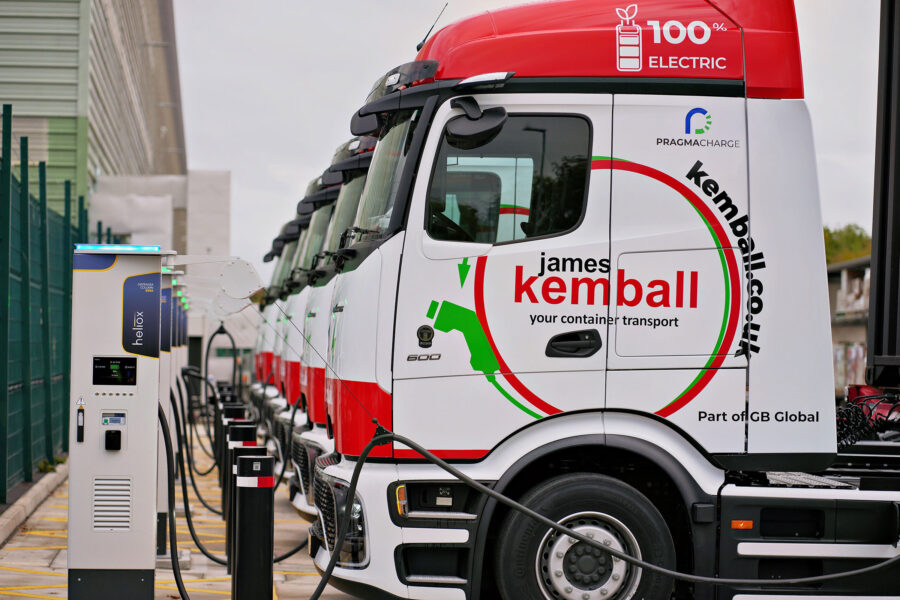
PragmaCharge has completed its first UK Electric Trucking-as-a-Service (eTaaS) deployment, with Asset Alliance Group providing funding for eight Mercedes-Benz eActros 600 electric tractor units. The vehicles have entered service with container transport specialist James Kemball at its Port of Felixstowe base.
The agreement brings together vehicle finance, charging infrastructure and fleet management software within a single monthly payment, offering an alternative to the substantial upfront investment typically associated with fleet electrification.
James Kemball, part of GB Global, will use the eight electric trucks for regional container movements within a round-trip distance of approximately 400km from Felixstowe. The vehicles are expected to cover a combined 900,000km annually.
Removing barriers to electric truck adoption
PragmaCharge’s Electric Trucking-as-a-Service model aims to address several of the financial and operational challenges facing hauliers considering electric vehicles.
These include higher vehicle purchase prices, charging infrastructure costs, range limitations and reduced payload capacity.
Rather than purchasing vehicles and charging equipment outright, operators commit to an annual mileage allowance, with costs calculated on a price-per-use basis.
The package supplied to James Kemball incorporates vehicle leasing, access to charging infrastructure and PragmaCharge’s proprietary electrification software.
The software helps operators assess the suitability of electric trucks for existing transport operations, plan their transition from diesel and optimise vehicle efficiency once the trucks enter service.
Rob Gwynn, Strategic Development Manager at Asset Alliance Group, facilitated the funding agreement.
Nikhil Amin, Chief Operating Officer at PragmaCharge, says: “It’s been great working with Rob and the team at Asset Alliance Group to deploy these assets with James Kemball.
“We see this partnership as an innovative and creative one. We look forward to working with Asset Alliance Group to introduce our Electric Trucking-as-a-Service offer to their existing customers, as well as our established customer base in Spain, Iberia, Poland and Germany.”
Electric container transport
James Kemball’s decision to introduce electric trucks reflects growing customer demand for lower-emission transport services, alongside concerns over diesel price volatility and long-term operating costs.
A spokesperson for James Kemball says: “These are our first steps to electrification, which given rising fuel costs and the volatility around fossil fuels will provide us with a stable cost base. Sustainability is important to us as a business generally and increasingly so to our customers.
“One of the first questions we are typically asked during tenders is about our decarbonisation roadmap. Working with PragmaCharge has helped us answer this, get us over the initial barriers to adoption, and bring the many threads involved in this process together into a viable proposition.”
Mercedes-Benz eActros 600
PragmaCharge selected the Mercedes-Benz eActros 600 for its suitability for regional container transport.
The battery-electric tractor unit offers a quoted range of up to 500km, peak motor power of 600kW and compatibility with megawatt charging technology.
Based on the anticipated annual fleet mileage, each vehicle will cover an average of approximately 112,650km a year.
Dedicated HGV charging infrastructure
Alongside the vehicle deployment, PragmaCharge has helped James Kemball install a dedicated electric HGV charging hub at its Felixstowe Distribution Centre.
The installation comprises two 360kW chargers feeding six dispensers, allowing up to six electric trucks to connect simultaneously, with a combined installed charging capacity of 720kW.
The agreement demonstrates an alternative approach to commercial vehicle electrification, combining vehicle funding, infrastructure and operational support within a single commercial package.
For haulage operators, the model offers a means of introducing electric trucks without committing substantial capital to vehicle purchases and charging infrastructure at the outset.