
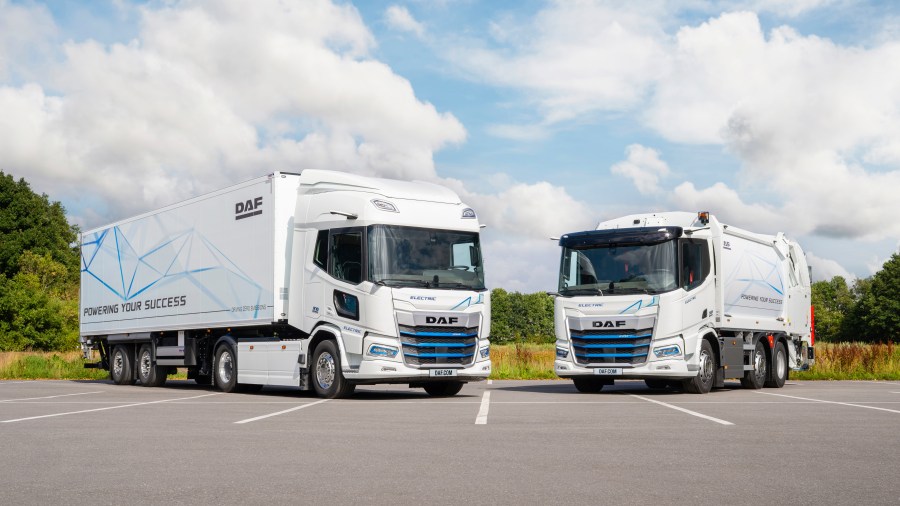
DAF Trucks UK ends the year on a strong note, supported by continued market leadership and significant progress in electrification. Across both diesel and zero-emission product ranges, the company expanded its portfolio, sped up customer deployments, and relied heavily on a dealer network that demonstrated both innovative capacity and resilience in the face of serious operational challenges.
Phil Moon, Marketing Manager, and Adam Bennett, EV & Sustainability Manager, highlighted a year characterised by technological progress and the growing maturity of DAF’s support infrastructure for electric fleets.
DAF’s 30-year dominance in the UK heavy truck sector remained secure, with market share at 30.4% at the end of October and expected to remain close to that level by year’s end. While the overall UK market softened from last year’s total of just under 45,000 vehicles, DAF maintained a strong order pipeline, supported by new model-year updates and continued product refinement.
Electrification became a defining aspect of 2025. The new-generation DAF Electric range entered full production, covering 12- to 42-tonne applications across the XB, XD, and XF platforms, with e-motor outputs from 120 to 350 kW and battery capacities up to 525 kWh gross. DAF remains the only OEM committed to LFP battery chemistry across the entire electric range, offering improved sustainability, reduced reliance on vulnerable materials, and greater resistance to thermal runaway. Bennett also highlighted DAF’s eight-year / 4 MWh-per-kWh battery warranty, equivalent to roughly 4,000 charge cycles, which few real-world operations are likely to exceed.
The UK’s share of electric HGV registrations remains small but is growing rapidly. Electric trucks above six tonnes made up 1.4% of the market this year, up from 0.5% last year, with Q3 alone reaching 2.4% and recording 225 electric trucks, the largest quarter on record. Much of this growth comes from the ZEHID programme, with DAF supplying vehicles across three consortiums targeting the most challenging heavy tractor decarbonisation. More than 55 DAF electric vehicles were already in UK and European service by autumn, collectively covering over 500,000 kmand removing 300,000 kg of CO₂ from operations, with an average energy consumption of 1.1 kWh/km and real-world ranges that consistently surpass DAF’s stated figures, including some operators reporting 300 miles on a single charge under favourable conditions.
DAF’s progress in electrification has depended heavily on substantial investment in charging infrastructure. Several dealer locations now feature 180 kW DC chargers, with more sites being added throughout the year, and DAF has introduced 40 kW mobile charging units to assist operators in gradually transitioning without needing fixed installations. Bennett described mobile charging as a vital early-stage solution, allowing overnight charging for single-shift vehicles and even five-pack tractor units using just a 63-amp commando socket.
Much of the company’s success this year is attributed to the resilience of its dealer network. With 136 UK and Ireland DAF locations and an additional 10 TRP service/parts centres, the network remains entirely independent and entrepreneurial, yet is coordinated to provide consistent aftersales support. Collective dealer investment in recent years now totals around £100 million, including major upgrades across the south-west, central Scotland, and Cornwall, with 24 more workshop bays added in the past year and over 3 km of workshop lane capacity expanded since 2018.
No story better illustrates dealer resilience than the Norscot fire in February. A catastrophic workshop fire destroyed the facility, yet technicians were carrying out diagnostics in the yard the next morning, servicing vehicles outdoors in winter conditions, and operating from a temporary facility within days. They did not miss a single operational day or a single DAFaid call-out, and by January they were already moving back into the rebuilt workshop, less than a year after the incident.
Technician recruitment and training also advanced. The DAF Apprentice Academy in Nottingham officially opened in February, featuring 18 bays and supporting apprenticeships in technical skills, parts, and sales. Across the network, 767 technicians are now employed, up from 663 last year, with 155 new apprentices joining this academic year and an estimated 3,000 graduates over the programme’s 30-year history.
Product innovation also stayed active throughout the year. Model Year 25 diesel updates introduced revised valve timing, reduced parasitic losses, and a further 3% fuel efficiency improvement over the already-efficient 2021 New Generation models. New comfort, safety, and infotainment features are now standard across the range, with DAF surpassing General Safety Regulation requirements in several areas.
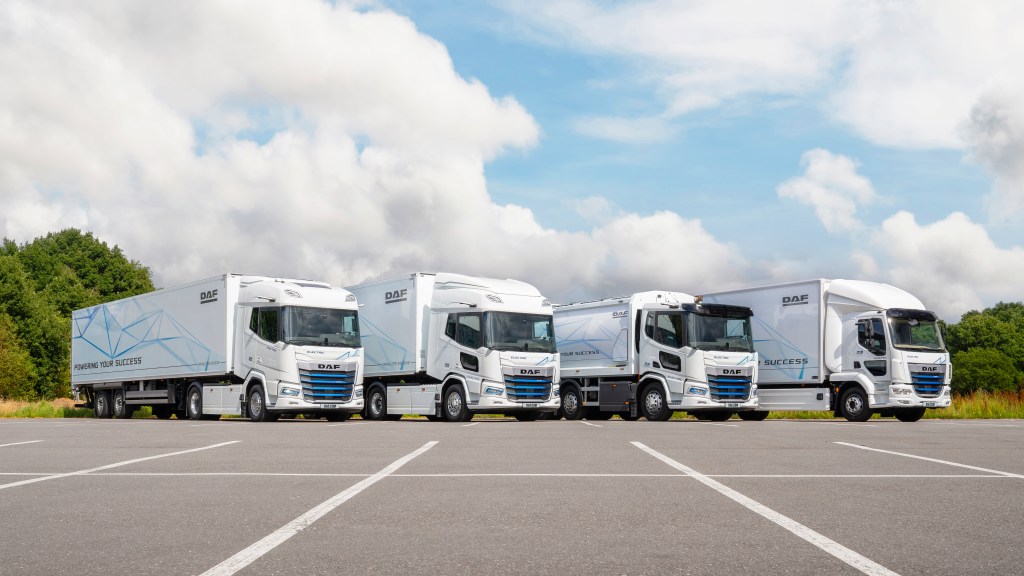
DAF’s operational milestones continued throughout 2025:
• 10,000th XB produced at Leyland (March)
• 125,000th New Generation DAF built at Eindhoven – the fastest-ever programme to reach that milestone (April)
• 300,000th DAF multi-support contract signed (April)
• Turners receiving their 1,000th New Generation DAF, with every model represented from XB to XG+ (mid-year) .
Awards further reinforced the momentum:
• XF – Fleet Truck of the Year
• XB – Best Truck up to 7.5t (Fleet Awards 2025)
• XD & XF Electric – International Truck of the Year 2026, recognising real progress in zero-emission HGV capability .
Bennett also outlined a significant commercial EV offer centred on contract purchase, utilising the 100% first-year EV capital allowances (available until March 2026) and the Plug-in Truck Grant. This enables five-year TCO parity between a five-pack electric XD tractor unit and its diesel equivalent. The offer includes full R&M, DAF Fleet Services support, and optional mobile chargers, capped at 100 units, with strong interest from operators focused on decarbonisation or subject to low-CO₂ contract requirements.
Looking ahead, DAF is pushing for policy changes to speed up the adoption of electric HGVS, including adjusted weight limits, expanded or re-tiered Plug-in Truck Grants, additional depot-charging funding rounds, and reforms to electricity pricing. Operator-level CO₂ reporting and possible urban access regulations are also seen as likely drivers for increased demand .
DAF concludes the year with strong diesel performance, expanding electric momentum, and a dealer network that has shown both capacity and resilience. As Moon noted, market leadership relies as much on aftersales capability as on product competitiveness. Electrification is no longer a side project but an increasingly central element of DAF’s strategy and, in practice, its daily operations.
More information:
DAF Trucks – DAF.co.uk
For more like this visit the Trucking Magazine website (truckingmag.co.uk), or subscribe to Trucking Magazine here (https://shop.kelsey.co.uk/trucking-magazine).